
When Coping Skills Stop Working

When you're doing all the “right” things and still don't feel better
If the coping skills that used to help your anxiety or emotional overwhelm aren't working anymore, it doesn't necessarily mean you're doing them wrong.
Sometimes your nervous system is carrying more than your coping strategies can manage. And sometimes the skills that helped you survive, function, achieve, parent, or keep going were never meant to address the deeper experiences underneath the symptoms.
Coping skills matter. They can help us regulate, pause, ground, breathe, and come back online.
AND sometimes coping isn't the same thing as healing.
When you find yourself using every tool you know and still struggling, it may be time to become curious about what your symptoms have been trying to manage or protect you from.
Maybe you know the list by heart.
Take a breath.
Go for a walk.
Journal.
Meditate.
Exercise.
Use your grounding techniques.
Call a friend.
Get more sleep.
Challenge the thought.
You've learned the coping skills. You've practiced them. Maybe they really did help for a while.
But lately?
The breathing isn't touching the anxiety.
The walk helps for twenty minutes, and then the overwhelm comes right back.
You're journaling about the same thing you've journaled about a hundred times.
You know exactly what you're supposed to do—and somehow it still doesn't feel like enough.
That's an incredibly frustrating place to be.
Especially if you're someone who is used to being competent.
You're the high-achieving college student who normally figures things out.
You're the single mom who keeps everything moving because people depend on you.
You're the person with complex trauma who has spent years learning how to function despite what you've lived through.
When something that used to work stops working, it's easy to turn on yourself.
Why can't I get this under control?
I know better than this.
I've done so much work on myself.
Why am I back here again?
But I want to offer you another possibility.
Hopeful Heart Insight: Maybe Your Coping Skills Aren't Failing
Maybe they're giving you information.
Coping skills are incredibly valuable. I teach nervous system regulation skills in my own therapy practice.
A pause.
A breath.
Shaking some of the activation out of your body.
Feeling your feet on the ground.
Looking around the room and reminding your nervous system where you actually are.
These practices can help when anxiety or a trauma response takes over.
When we become highly activated, we don't have the same access to the parts of our brain responsible for reasoning, perspective, impulse control, and intentional decision-making.
Sometimes we need to help the nervous system settle so those parts can come back online.
That's regulation.
But here's an important distinction:
Regulation gives us access to choice. It doesn't necessarily resolve what keeps activating the nervous system in the first place.
And eventually, that distinction can matter.
When You're Doing Everything “Right”
When coping skills stop working as well as they once did, it can look surprisingly ordinary.
Maybe you meditate every morning but spend the rest of the day bracing for the next thing to go wrong.
Maybe you exercise because it helps your anxiety, but you're increasingly panicked on the days you can't work out.
Maybe you have excellent boundaries on paper but freeze the moment someone is disappointed in you.
Maybe you know five grounding exercises but still become completely overwhelmed during conflict.
Maybe you're the student who knows exactly how to organize your workload, yet one disappointing grade sends your body into panic.
Maybe you're a single mom who waits until the kids are asleep to finally “relax,” only to discover that your body has no idea how to stop.
Or maybe you've done enough therapy that you understand exactly why you do what you do.
You know the childhood experience.
You recognize the people pleasing.
You understand the attachment pattern.
You can identify the trigger.
And then the trigger happens...
and you do the same thing again.
That can feel defeating.
But understanding a pattern and changing a pattern are not the same process.
Your Brain Has Been Practicing, Too
I often explain this to clients by asking them to imagine the Grand Canyon.
Many of our default neural pathways began developing very early in life. The patterns we repeat—especially the ones connected to safety, relationships, fear, belonging, and survival—can become incredibly well traveled.
Imagine that old response as the Grand Canyon.
Deep.
Familiar.
Easy for the brain to find.
Then you learn something new.
Maybe instead of automatically saying yes, you want to set a boundary.
Instead of shutting down during conflict, you want to stay present.
Instead of assuming someone is angry with you, you want to tolerate not knowing what they're thinking.
You're trying to create a completely different path.
At first, that new pathway isn't going to feel like the Grand Canyon.
It's more like making a left turn when you've spent years automatically turning right.
You have to notice the intersection.
Pause.
Regulate enough to come back online.
And then intentionally make the left turn.
And you have to do it again.
And again.
And again.
That's not motivational language. Our brains are capable of change. Experience and repeated practice can strengthen neural pathways throughout life.
So when you fall back into an old pattern, instead of:
What's wrong with me?
I want you to consider:
Of course my brain went there. I've traveled that road thousands of times.
And then we practice the left turn again.
Capacity, Not Character
This is where one of the central ideas in the Hopeful Heart approach becomes especially important:
Capacity, not character.
If you were able to manage your anxiety six months ago and now you're struggling, it doesn't automatically mean you've become weaker.
Your capacity may have changed.
Maybe you're carrying grief.
Maybe you're parenting without enough support.
Maybe school has intensified.
Maybe your relationship feels uncertain.
Maybe you're sleeping poorly.
Maybe old trauma has been activated.
Maybe you've spent years overfunctioning and your nervous system is simply tired.
A person with less available capacity often needs more support—not more self-criticism.
Sometimes the question isn't:
Why aren't my coping skills working?
It's:
What am I asking these coping skills to carry?
The Hopeful Heart AND
We have a tendency to think healing means choosing between two possibilities.
Either coping skills work or they don't.
I'm getting better or I'm getting worse.
I'm strong or I'm struggling.
But healing rarely fits neatly into either/or.
This is where I use something constantly in therapy:
AND.
My coping skills help me AND something deeper may need attention.
I understand my trauma AND my body still reacts to it.
I've made tremendous progress AND I'm struggling right now.
I can regulate myself AND sometimes I need someone else to help me regulate.
I am incredibly capable AND I don't have unlimited capacity.
I can appreciate the strategies that helped me survive AND decide they aren't how I want to live anymore.
Being able to hold both truths creates flexibility.
And flexibility gives us more choices.
Coping Around Something vs. Healing It
Imagine there's a smoke alarm going off in your house.
A coping skill might help you tolerate the sound.
And sometimes that's exactly what you need in that moment.
But eventually we also want to ask:
Why does the alarm keep going off?
That's where trauma processing can be different from symptom management.
When someone has experienced trauma—particularly chronic, relational, or developmental trauma—the nervous system may have learned very early that certain situations require protection.
Conflict might mean danger.
Disappointing someone might mean rejection.
Rest might feel unsafe.
Being imperfect might threaten belonging.
Needing someone might feel dangerous.
Your nervous system learned those associations for a reason.
And sometimes the coping skills we've collected are helping us manage the anxiety those patterns create without changing the underlying pattern itself.
That doesn't make coping skills useless.
It means they may only be one part of healing.
Today's Hopeful Heart Micro Practice: Ask a Different Question
The next time you notice yourself reaching for a coping skill, use it.
Take the breath.
Ground yourself.
Move your body.
Go outside.
Do whatever helps you come back online.
But after you have a little more space, try adding one question:
What is my nervous system trying to protect me from right now?
Don't force an answer.
And don't turn it into an investigation of everything that has ever happened to you.
Just notice.
Maybe the answer is rejection.
Failure.
Conflict.
Being judged.
Losing control.
Being alone.
Disappointing someone.
Not knowing what's going to happen.
Or maybe you don't know yet.
That's okay too.
The micro practice isn't figuring everything out.
The practice is becoming curious about what's underneath the symptom instead of immediately trying to make the symptom disappear.
That is a very different relationship with yourself.
Moving From Coping to Processing
Trauma therapy can help us go beyond managing the nervous system's reactions and begin working with the experiences, beliefs, emotions, and protective patterns underneath them.
In my work, that can include trauma processing approaches such as EMDR, attachment-focused work, nervous system regulation, and understanding how earlier experiences continue to shape present-day responses.
And here's something I think is especially important:
We don't have to hate the old pattern in order to change it.
If people pleasing once helped you maintain connection, we can understand that.
If hyper-independence once helped you survive disappointment, we can respect that.
If perfectionism helped you create predictability in an unpredictable environment, that makes sense.
AND we can ask whether that strategy still serves the life you want today.
That's where therapy becomes more than symptom management.
We're not just trying to make you better at tolerating the life you're already living.
We're helping you develop enough awareness, regulation, flexibility, and internal safety to have more choices about how you want to live it.
Coming Home
There is a reality about being human that I return to often in therapy:
Life contains pain.
Life contains uncertainty.
And being human requires ongoing work.
Healing doesn't remove those things.
I don't believe the goal of therapy is to create a life in which you're never anxious, triggered, overwhelmed, disappointed, or hurt again.
The goal is developing a different capacity for meeting those experiences.
You notice what's happening.
You recognize when your nervous system has taken over.
You help yourself come back online.
You become curious instead of critical.
You create enough flexibility to see that the old road isn't the only road.
And then, little by little, you practice another turn.
Sometimes that's a coping skill.
Sometimes it's deeper trauma processing.
Sometimes it's asking someone for emotional support.
Sometimes it's setting a boundary.
Sometimes it's resting.
Sometimes it's simply noticing:
Oh. I'm back in the Grand Canyon.
And remembering:
There is another road.
A Final Hopeful Heart Truth
If your coping skills aren't working the way they used to, you haven't necessarily failed at healing.
Maybe you've reached the point where managing the symptoms isn't enough anymore.
That can be frustrating.
AND it can also be information.
Your nervous system may be asking you to listen a little more closely to what it has been carrying.
You don't need to throw away the coping skills that have helped you.
You may simply be ready to add something deeper.
Ready to Move Beyond Coping?
If you've been doing everything you know to manage anxiety, emotional overwhelm, or trauma responses and still feel like you're struggling, trauma therapy can help you understand what may be happening underneath the symptoms.
At Hopeful Heart, I work with adults who are ready to move beyond simply getting through the day and begin understanding and changing the patterns that keep pulling them back into survival mode.
If you're curious about whether trauma therapy might be a good fit for you, reach out to Hopeful Heart to schedule a consultation.
You don't have to arrive knowing exactly what needs to change.
Sometimes we start by becoming curious about what your nervous system has been trying to tell you.
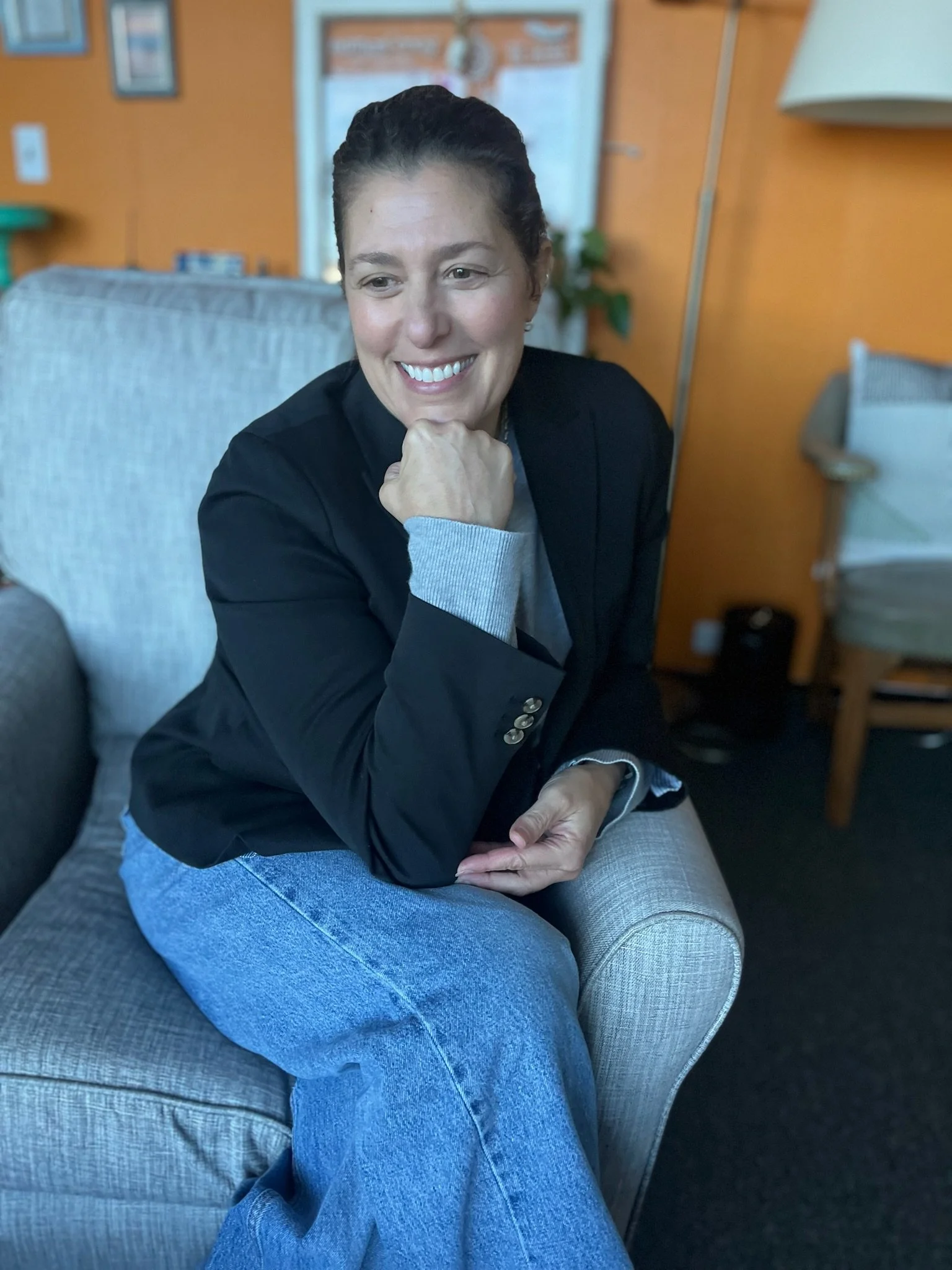
About Sari
Sari Glazebrook, LCSW, is a licensed clinical social worker and founder of Hopeful Heart LLC with more than 15 years of experience helping adults heal from trauma, anxiety, chronic stress, emotional overwhelm, and longstanding survival patterns. Based in the north suburbs of Chicago, Sari specializes in trauma-informed therapy and integrates approaches including EMDR, attachment theory, nervous system regulation, brain science, and holistic practices.
At Hopeful Heart, Sari helps clients understand why their patterns developed, build greater internal safety and emotional regulation, process unresolved trauma, and create meaningful change in their relationships and lives. Her work is grounded in a simple belief: the patterns that helped us survive deserve compassion—and with awareness, safety, repetition, and support, our brains and nervous systems can learn something new.